A voice in the chest
Dear Watchers,
I love listening to music so much I could not live without it. It touches me. Not in the head that sorts. Lower. Behind the sternum, in the throat, sometimes all the way into the legs. Violin and cello do this better than almost anything: they borrow enough from the human voice for the body to recognize itself, and enough strangeness for the body to grow uneasy. A second voice. Not an ornament.
People have said too often that the violin “makes you cry.” That is a comfort phrase. The bow can also consecrate, threaten, light a clarity in the chest, lay down a weight of mourning that words would refuse. The cello, lower, often holds the ground: desire, fatigue, prayer without a named god. Together they do not comment on a scene. They pass through it, and they make you pass through it.
I will not give you a taxonomy. I will follow that voice where it found me, station by station, and let each listening displace the one before.
Boléro: the first wow
My very first “wow” at a violin, or rather at violins, was the moment they took the bow and seized the main melody of Ravel’s Boléro, a few seconds after the tenth minute, done with pizzicato accompaniment from the start. They bring the lyrical power that drives the tension upward in crescendo, beside the military drum that holds the sixteen-bar rhythmic motif without flinching. It is striking how deeply the Boléro marked my child’s mind. The way tension rises without stopping, carried by that progressive entry of the strings, is almost hypnotic.
 Listen to the Boléro
Vampire: myth, screen, soundtrack
Later, as a teenager, I rediscovered that voice in a literary register. In Anne Rice’s Vampire Chronicles, Lestat is not only a cape silhouette. The violin belongs to his legend; it touches what should have stayed asleep. The image stuck: strings equal night, seduction, elegant danger. I was fascinated. Cinema gladly typecast the bow in that register, as if the instrument only knew how to speak postcard gothic.
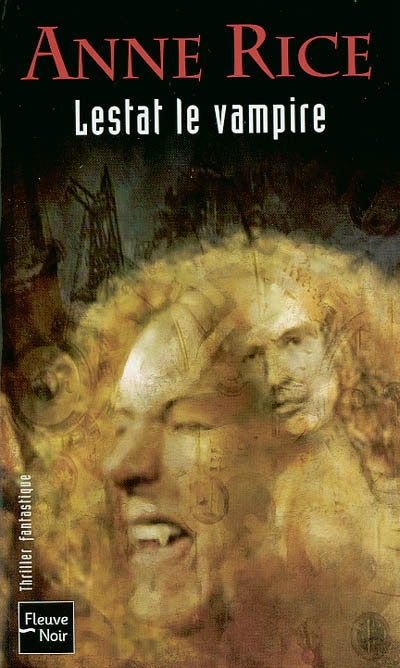
One more paragraph in Anne Rice’s world and on screen. After Interview with the Vampire came Queen of the Damned (2002), adapted for the wide screen. I found the first film very good, with Tom Cruise superb as Lestat (you feel he read the Chronicle to inhabit the Brat Prince; I love the actor as much as I dislike the public figure). The second is meh. The film, for me, is rather average: diluted myth, images that try too hard. The soundtrack holds. It almost saves the screening. Produced in Jonathan Davis’s orbit (Korn) with Richard Gibbs, it carries the nu-metal of the era, its scraping textures, its raw wound. And above all, it refuses the easy gesture. The script asked for “Paganini-style” violin, stock classical varnish for a chic vampire. Davis and Gibbs said no. They brought in L. Shankar and his double-neck violin. Another spirituality. Another bow. Already hovering, already outside the Hollywood costume.
 Hypnotic, I tell you: a cut from the OST
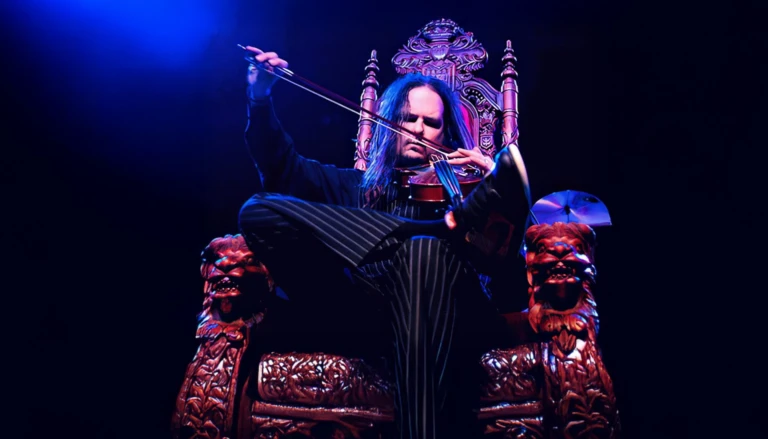
That detail matters to me. Davis is not only a screamed vocal and stage bagpipes. A multi-instrumentalist, he also plays violin; later he would say he learned from Shankar, plugged into an amp, with no competition pretension. In Korn, the sounding body is an obsession: what scrapes, what rasps, what does not console cleanly. That the same man reaches for strings to clothe Lestat is not a marketing crossover. It is the same quest for a voice that travels under the skin, only with another tool. And there is Shankar already haunting the film I find average. The OST knows what the film misses: the shiver does not need the décor.
Gothic metal: when the bow equals the riff
A branch of metal took that voice as an icon. Not all of gothicism (gothicism has a thousand doors; many live without a bow). But in gothic metal, in doom tinted with atmosphere in the 1990s and 2000s, the violin became almost a stage sacrament. Tristania. The Sins of Thy Beloved (home, incidentally, of Pete Johansen, the violinist who also haunts Tristania). Strings forward, voices in contrast, melancholy that does not apologize. Is it a particular trait of gothicism? No, if one claims the universal. Yes, if one speaks of this musical gothicism: there, the bow equals the riff. It does not decorate the dark. It sings it.
Dear Watcher, I do not know which track to hand you; so many marked me. Let us take Tristania and A Sequel of Decay: haunting from the first note. It closes Beyond the Veil (1999), which I consider Tristania’s masterpiece of symphonic gothic metal. The piece rests on a heavy, slow, melancholic atmosphere where Pete Johansen’s violin is crucial.
The track opens on a piercing, isolated violin melody, immediately joined by a discreet piano and the sound of driving rain: a dark theatrical set before the song even begins. Then the dialogue of voices: Vibeke Stene’s crystalline lyric singing against Morten Veland’s spoken or whispered line, intimate and resigned. Saturated vocals (growl) are almost absent; the lament takes the floor. Unlike the band’s more aggressive tracks, the violin here is insistent. It is not mere accompaniment: it carries the main theme, returns between verses, deepens the sense of decay. Heavy guitars and mid-tempo drums support the line without smothering the acoustics or the voice. One of the group’s most stripped and emotional pieces: spleen and dramatic beauty over velocity. Yes, I love this band. It deserves several posts of its own.
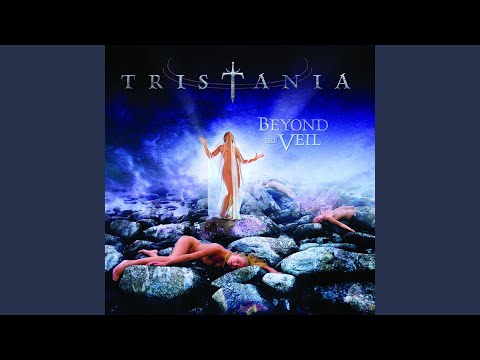 Tristania, A Sequel of Decay
Epica: the voice that confronts
Then the line widens. Epica, Design Your Universe (2009). I return to it the way one returns to a room where the air has density. For me it is their peak of symphonic balance: the metal does not apologize for being heavy, the orchestration is not a varnish of respectability. On Kingdom of Heaven, a long suite in the A New Age Dawns saga, the strings do not soften. They push. They attack with the rest. Heaviness and bow hold like two breaths of the same body.
This is no longer only gothic melancholy in costume, the spleen of A Sequel of Decay prolonged. It is a spirituality of combat. The second voice does not only plead: it confronts. When the strings enter the heaviness, I feel the same rise as in the childhood Boléro, but armed, theatrical in another way. The bow no longer waits until the tenth minute to dare the melody. It is already in the assault.
 Epica, Design Your Universe
Falling In Reverse: strip the noise to hear the nerve
Later I heard Falling In Reverse strip the noise from their own songs. The Drug In Me Is Reimagined (2020). I’m Not A Vampire (Revamped) (2021). Last Resort (Reimagined) (2023). Piano, violins, violas, cellos, crescendos that could be film score.
The gesture touches me less as a “classy version” than as an admission. Under the overdriven punk, under the post-hardcore, there was already a lament. The Drug In Me Is Reimagined turns a charge into a complaint: piano opens, strings carry what gain had smothered. I’m Not A Vampire (Revamped) leans toward film drama; violas and violins tense the air. Last Resort (Reimagined) rides a crescendo of violins and cellos under the vocal, a Papa Roach cover become something else. Strings do not add nobility. They make the nerve audible. As if the second voice had always been there, and was finally given air again.
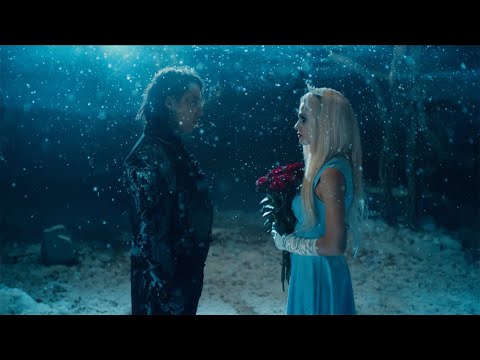 Falling In Reverse, The Drug In Me Is Reimagined
Clara Ysé: no myth required
Change of air, almost of inner continent. Clara Ysé, Le monde s’est dédoublé. Sary Khalifé’s cello (especially in the live capture that caught me) plays neither vampire nor metal cathedral. It plays the tipping: that morning when the real splits, when things lose their density, when a friend murmurs and the body no longer hears the same way. There the second voice no longer needs the myth. It is enough. A barer spirituality, closer to breath. Yet I recognize the same family of affect: it touches before it explains. It moves through the chest before judgment has time to file it away. Thanks to my friend Rita for this delicious discovery.
 Clara Ysé, Le monde s’est dédoublé (live)
Clair Obscur: games too
And games. Yes: I remain a geek, a gamer, a music lover. Clair Obscur: Expedition 33. Lorien Testard’s soundtrack (with Alice Duport-Percier and others) reminded me of an obvious truth we still forget: video games have no reason to cede strings to cinema. Alicia (Violin), Nisa Addina on the bow: few words. Mourning, paint, a world held by a line. Games are allowed to have violin. They do. And when it is true, the shiver is the same as in a dark theater or in front of an amplifier. The medium changes. The chest does not.
 Lorien Testard, Alicia (Violin)
Shankar: two necks, the loop
I could stop there. But the loop wants its close. L. Shankar (sometimes Shenkar) designed a ten-string stereophonic double-neck electric violin: from bass and cello range up through viola and high violin, hovering pads, resonance from one neck to the other. Born of the concrete need to stop stacking overdubs, the instrument became something else: a full range inside one body of wood and wire. Carnatic spirituality, rock, jazz, in the same gesture. We already heard it haunt Queen of the Damned. You can listen for its own sake, without vampire, without synopsis. The shiver never needed the costume. It needed a voice wide enough to hold the world’s low and high.
 L. Shankar, double violin
That is what I was holding, underneath, while lining up these listenings. Not a thesis on “the violin in culture.” A repeated experience: somewhere between skin and breath, bowed strings open a second voice. Styles displace it. They do not exhaust it. If you have already felt it, you will know why I wrote. If you have not felt it yet, choose a single title from this path, lower the rest of the world, and listen with the sternum, not with the catalogue.
Sources
- Ravel, Boléro (listening ref.). Violins taking the melody; childhood memory.
- Queen of the Damned soundtrack. Davis / Gibbs; Shankar (double violin); 2002 nu-metal context.
- Metal Hammer / Louder: Jonathan Davis on the OST. Refusal of stock “Paganini”; Shankar pitch.
- Jonathan Davis. Violin among his instruments.
- Louder interview: Davis learns violin with Shankar. Alone I Play tour.
- Tristania, Beyond the Veil. 1999; A Sequel of Decay; Pete Johansen (also The Sins of Thy Beloved) on violin.
- Epica, Design Your Universe. 2009; Kingdom of Heaven.
- L. Shankar / Double Violin. Ten-string double-neck; use on Queen of the Damned.
- Clara Ysé, live Le monde s’est dédoublé. Cello: Sary Khalifé.
- Lorien Testard, Alicia (Violin). Clair Obscur: Expedition 33 OST; violin Nisa Addina.